

The quiet revival of the Cycladic vernacular.
An Editorial Desk essay. A younger generation of Greek architects is returning to local stone, lime and hand-craft on the Cyclades. The real rules and economics behind the shift, and the built projects, from Serifos to Antiparos, that show it.
In brief.
- The essay. This is an Editorial Desk essay: no reliable survey measures how much Cycladic building has turned back to local stone, so the case rests on the rules, the economics and the built work, not on a percentage.
- The rules. Building in Cycladic traditional settlements is governed by presidential decrees — the 1978 protection decree, the 1989 Cyclades decree that requires traditional façades and materials, and the 2025 decree for small settlements — administered by the Environment ministry, not Culture.
- The work. The revival is visible in named projects: Sinas Architects' Xerolithi on Serifos, K-Studio's Villa Mandra, Kapsimalis on Folegandros, Tsolakis on Antiparos. The Cyclades are returning to a language they already had.
The Signal
There is a real shift underway in how the Cyclades are being built, and it is worth being honest about how we know. No credible survey has measured it, and the tidy statistics that circulate about it, so many per cent of new houses turning back to local stone, do not come from any body that actually counts. So this is an essay, built on three things that can be checked: the rules that govern building on the islands, the economics of getting materials there, and the projects that architects have published. On all three, the direction is the same.
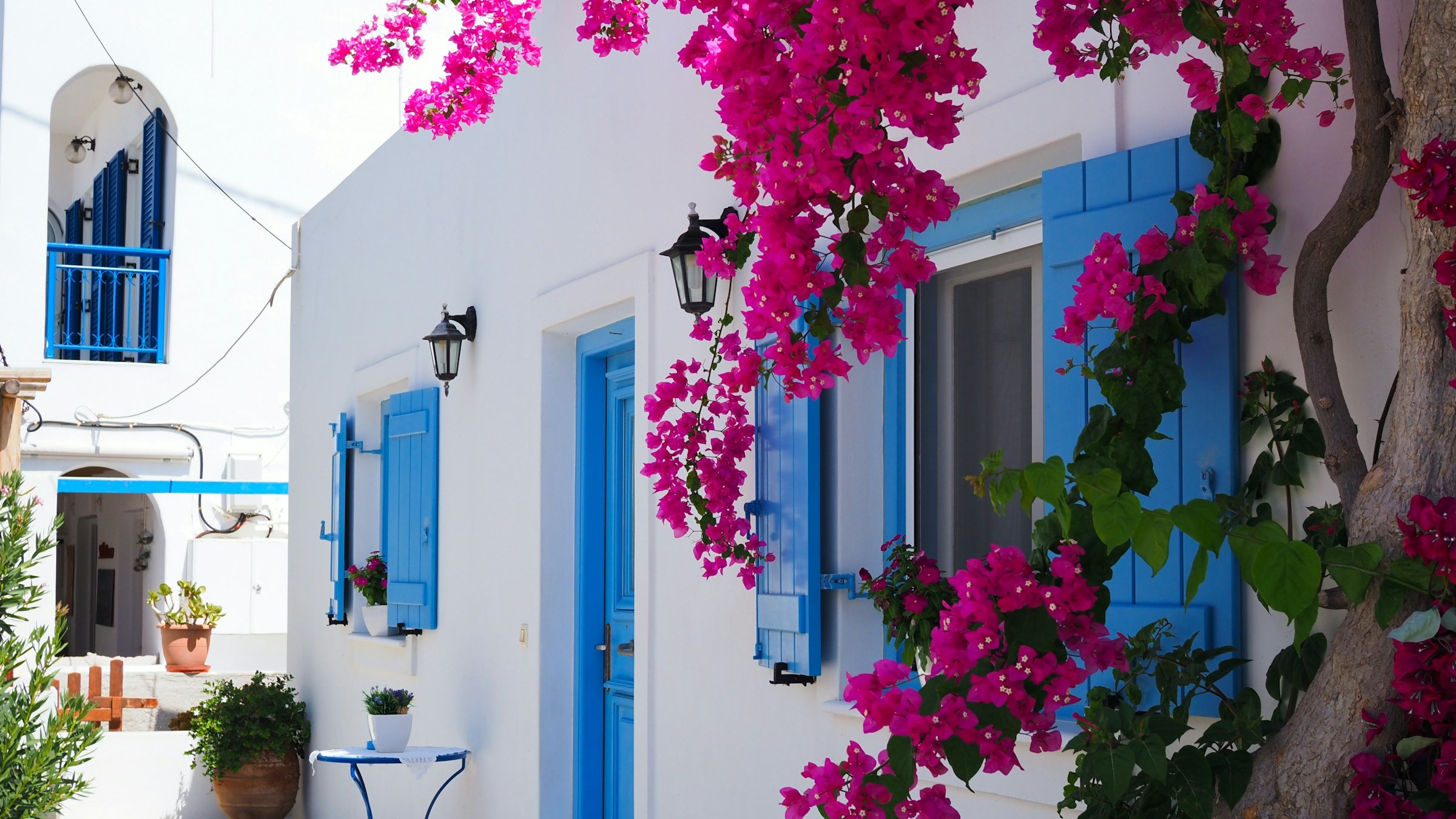
The vernacular in question is the pre-industrial grammar of the islands: load-bearing stone walls finished in lime, small openings, flat or vaulted roofs, cisterns and courtyards. For a decade the high-end Cycladic house drifted away from it, toward white render, large glass and imported finishes. The newer work is drifting back, and it is doing so for reasons that are structural rather than nostalgic.
The rules
Start with the regulation, because it is the part most often got wrong. Building inside a Cycladic traditional settlement is not governed by a "Ministry of Culture materials directive"; it is governed by presidential decrees promoted by the Ministry of Environment and Energy. The foundational one, published in the Government Gazette in 1978, designated the traditional settlements and set their building limits. The decisive one for the Cyclades came in 1989, and it is explicit: external façades are to be formed according to traditional prototypes in their materials and construction methods, heights are capped, and the old stone-paved lanes cannot be turned into roads. That decree, not a recent directive, is what has long pushed island building toward local stone and lime.
The framework is still tightening. A 2025 presidential decree re-regulated building in settlements under two thousand residents, and through late 2025 the Environment ministry froze out-of-plan permits on Mykonos and Santorini pending new special urban plans, with fresh zoning for named settlements such as Imerovigli and Finikia. The regulatory direction, in other words, is toward more vernacular discipline, not less.
The economics, and the work
Then the money. Imported steel, glass and engineered timber have all grown more expensive, and the sea-freight premium to get them to Tinos, Paros or Serifos does not shrink. On small-scale work, local stone, local lime and locally trained masons increasingly clear at a comparable or lower delivered cost, especially on restoration inside the protected perimeters. The rules ask for the vernacular; the freight bill increasingly agrees.
The proof is in the built work. Sinas Architects' Xerolithi House on Serifos is laid in dry stone, without joint mortar, taken straight from the island's agricultural retaining walls. K-Studio's Villa Mandra on Mykonos is built from stone dug on its own site. Kapsimalis Architects' stone-clad cave houses on Folegandros embed into the hillside behind locally sourced façades, and Tsolakis Architects' Encaved Stone Villa on Antiparos wraps local stone around chestnut and wicker. Tinos, with its marble villages around Pyrgos, remains the reference for the craft the others are drawing on. None of these is a composite; each is a published, photographed building.
What it means
The visible architecture of the next Cycladic decade will read closer to the unrestored vernacular than to the high-glass language of the 2010s, and it will do so because the rules, the freight economics and the architects are pointing the same way at once. What the revival does not do is change the underlying market: the Cycladic high end stays thin and price-led. What it changes is the grammar the high end is built in. The islands are returning to the language they already had, on a budget and under a rulebook that, for once, both permit it.
Frequently asked
What is the Cycladic vernacular?
The pre-industrial building grammar of the Aegean Cycladic islands: load-bearing stone walls coated in lime, flat or vaulted roofs supported on timber and reed structure, integrated cisterns, courtyards, and narrow staircases. The grammar is climatic, structural, and material at once, and it produced an urban form that has been continuously inhabited for centuries.
Which projects show the revival?
Named, published examples include Sinas Architects' dry-stone Xerolithi House on Serifos, K-Studio's Villa Mandra on Mykonos built from site stone, Kapsimalis Architects' stone-clad cave houses on Folegandros, and Tsolakis Architects' Encaved Stone Villa on Antiparos. Tinos, with its marble villages around Pyrgos, remains the reference for the craft.
Why is it happening now?
Cost and rules, pushing the same way. Imported steel, glass and timber have grown dearer while the sea-freight premium to the islands does not shrink, so local stone and masons are often the cheaper option on small work. And building in Cycladic traditional settlements is governed by presidential decrees — notably the 1989 Cyclades decree — that require external façades in traditional materials and forms.
Early Insider access
The week, read against the long present of Greece.
The Editorial Desk sends one email each Sunday morning, Athens time, with no noise and no churn, written for the professionals and operators who pay attention to Greece because they live, build, or invest in it. Early Insider access is opening in limited spots and closes soon.