

How one Greek developer quietly bought 6.2 million square metres of public coastline. And why nobody stopped them.
The Riviera Tower tops out a month ahead of schedule. A €500 million common bond opens its first interest period. 571 of 671 residences are sold or reserved. Read against the Bank of Greece's May 2026 Financial Stability Review, the week's announcements describe something more specific than a project update.
Key takeaways
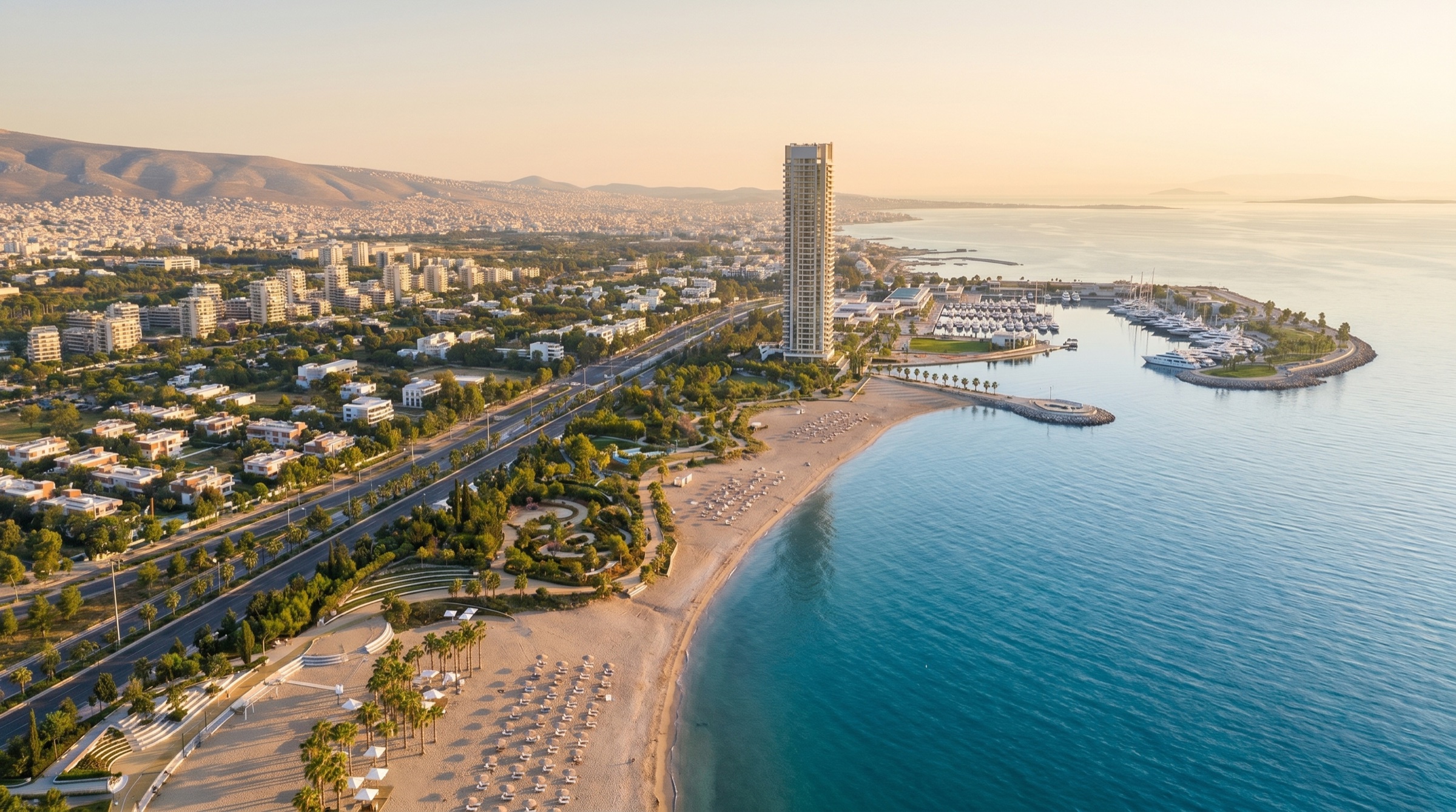
- The site. 6.2 million square metres of former Athens airport land plus the Agios Kosmas seafront, conceded as a single block to Lamda Development through TAIPED.
- This week. The Riviera Tower tops out at 50 floors, roughly a month ahead of schedule. Lamda opens the first interest period of its €500 million common bond on 14 May (3.80% coupon).
- Sales velocity. 571 of 671 residences marketed at Hellinikon are sold or reserved as of February 2026 (~85% conversion). Another 350 units launch mid-June, priced €550,000 to €4.5 million.
- The casino. A separate 30-year concession, held jointly by Hard Rock International (51%) and GEK TERNA (49%), branded Hard Rock Hotel & Casino Athens. A 197-metre, 42-floor tower, still targeted to open in 2026.
- The Riviera Galleria (originally announced as Marina Galleria). 23,000 square metres, Kengo Kuma design, 100+ retail outlets. Structural completion late 2026, operational opening spring 2027.
- Macro frame. The Bank of Greece's May 2026 Financial Stability Review devotes a chapter to housing supply, flagging NPL-collateralised stock as a structural drag. Golden Visa thresholds, set by Law 5100/2024, run three tiers: €800k in Attica, Thessaloniki and the larger islands, €400k in the rest of Greece, €250k for commercial-to-residential conversions; Law 5275/2026 later added a post-acquisition short-term-rental ban.
- The pattern. A coastline owned by no one in particular is becoming a place curated by a single owner.
What just happened
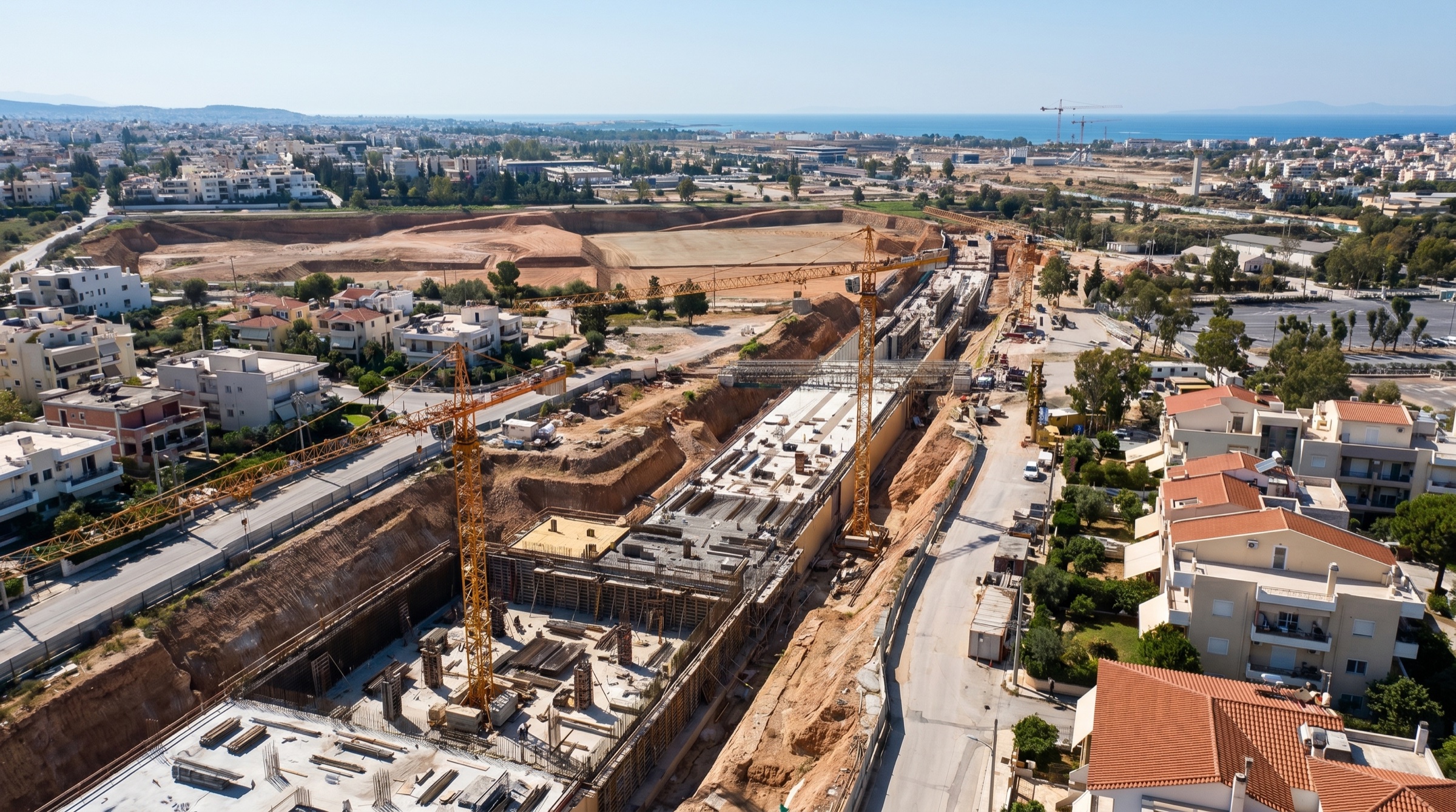
As we publish, Lamda Development is topping out the load-bearing structure of the 50-floor Riviera Tower, Greece's tallest building, about a month ahead of its June 2026 milestone. On 14 May, the company opened the first interest period of its €500 million common bond (KOD 2025, 3.80% coupon, record date 15 May, payment 18 May). On 12 May, Lamda's investor materials disclosed that 571 of 671 residences marketed at Hellinikon were sold or reserved as of 28 February 2026, an 85% conversion rate, with another 350 units due to hit the market in mid-June at prices spanning €550,000 for a one-bedroom to €4.5 million for a penthouse.
Read alongside the earlier May announcements (six approved skyscrapers, the operational framing of the Riviera Galleria, originally announced as Marina Galleria; the curatorial confirmation of an Olympic Airways museum inside the masterplan; and the commercial-axis hub on the coastal frontage), the picture is no longer a property-press headline. It is a velocity reading.
Each item, in isolation, is a project update. The pattern is something else.
The site, the concession, and the public-asset arithmetic
Hellinikon covers roughly 6.2 million square metres. It includes the runways and ancillary land of the airport that closed in 2001, plus the former Agios Kosmas Olympic facilities and a stretch of seafront that runs through Glyfada, Alimos, Elliniko, and Voula. That is a coastline of consequence. It is not a wasteland to be improved. For the residents of the surrounding suburbs, it has been functional public-edge land for decades, in the way that closed airport sites tend to be: fenced, inaccessible, but also unbuilt and visible from every coastal road.
The site was sold, in concession form, to a single developer through the Hellenic Republic Asset Development Fund, known by its Greek acronym TAIPED. The single-developer model is the structural fact that explains every subsequent design decision. Hellinikon is not a district master-planned by a city. It is an enclosure under one private masterplan, with the public-space provisions written into the concession contract and not into democratic land-use law.
The concession promised public space. A central park, announced at about 2 square kilometres, larger than London's Hyde Park, is the headline gesture. Beach access provisions, public transport commitments, and a "destination" coastal promenade are part of the package. The numbers, when they exist, will be reported by the developer and the state in the language of the contract, not in the language of how a city's people use a beach.
| Component | Type | Partner / Concession holder | Status |
|---|---|---|---|
| Riviera Tower | 50-floor residential tower, Greece's tallest | Lamda Development | Topping out, May 2026 |
| Hard Rock Hotel & Casino Athens | Integrated casino resort, 42-floor / 197 m tower | Hard Rock International 51% / GEK TERNA 49% | 30-yr concession, opening target 2026 |
| Riviera Galleria | 23,000 m² retail + dining quarter, Kengo Kuma design | Lamda Development | Structure late 2026, opening spring 2027 |
| Six skyscrapers | Mixed-use towers, Acropolis-sightline contested | Lamda Development | Council of State approved |
| Olympic Airways museum | Cultural institution, hangar-housed | Lamda Development | Confirmed inside masterplan |
| East Village & Skyline Havens | High-density residential, 150 + 350 units | Lamda Development | 571/671 sold or reserved · next 350 units mid-Jun 2026 |
| Commercial hub | Coastal commercial axis | Lamda Development | Unveiled |
| Hellinikon Park | Public open space, ~2 km² | Lamda (per concession) | Announced, phased delivery |
What the Hard Rock concession tells us
The casino partnership matters because it identifies the project's anchor. The Greek state issued a single integrated-casino licence in 2022 (a 30-year concession) that the Hard Rock International and GEK TERNA joint venture holds at the Hellinikon site, sitting beside, not inside, the Lamda concession. Hard Rock has built versions of this concept across the United States, the Caribbean, and Europe: a casino floor, a luxury hotel, conference space, retail, and a curated visitor environment around the gaming licence. Greece's tower is a 42-floor, 197-metre build, still pointed at an opening in 2026.
This is not a moral judgement. Integrated casino resorts exist in many cities. The point is what the anchor tells us about the rest of the masterplan. A 30-year casino concession sets the design language and the security choreography for a wide perimeter around it. The visitor is the unit of design. The resident of Glyfada and the swimmer at Alimos are not.
The skyscrapers, the museum, and the Riviera Galleria
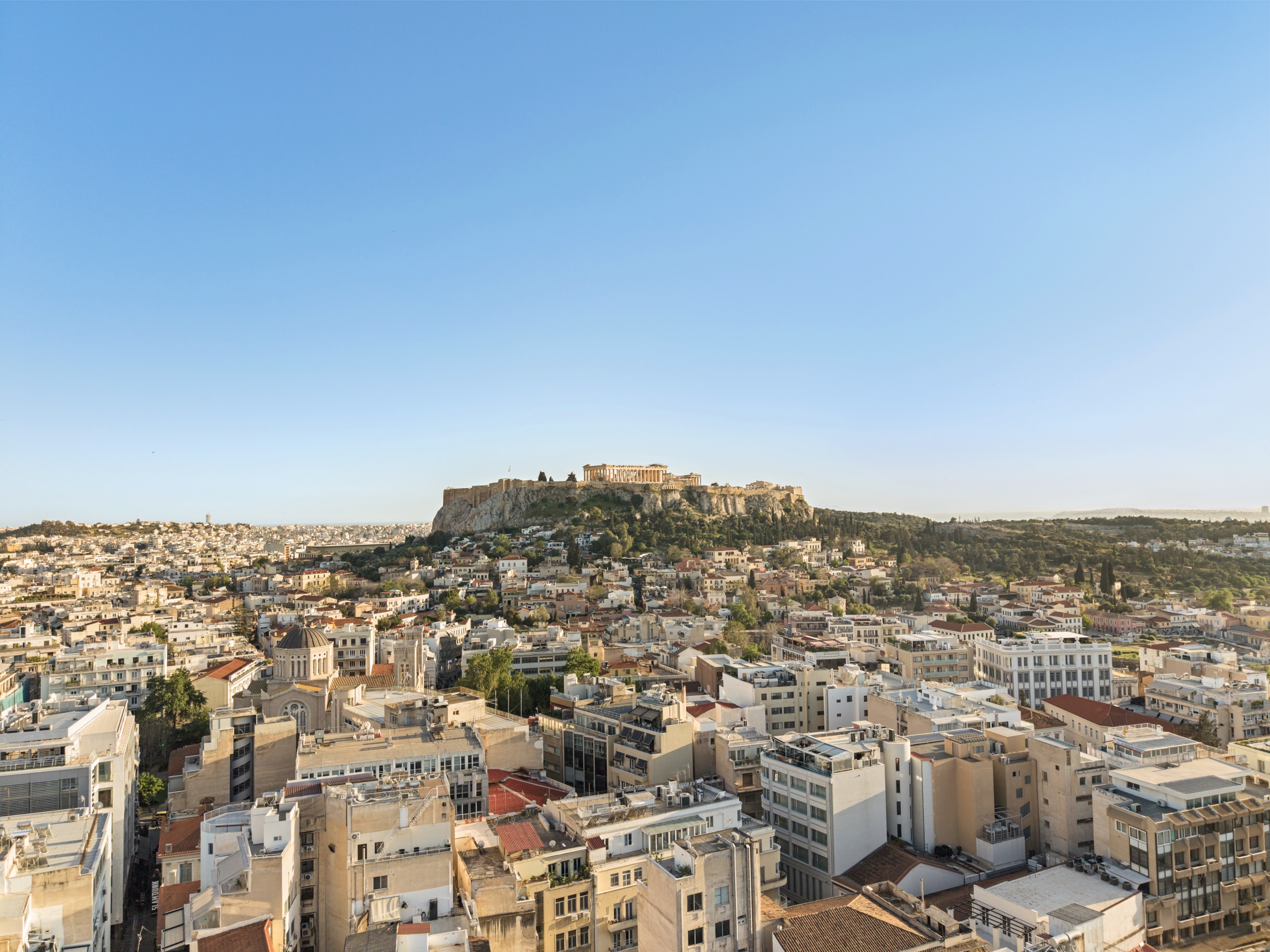
Six skyscrapers approved at the former airport. Athens has resisted height for most of its modern existence. The Acropolis sightline rules and the seismic constraints of the Attic basin have been the working consensus. Hellinikon breaks the consensus with state authorisation. The towers will be visible from the historic centre on a clear day. Whether that is a generational aesthetic loss or a generational urban gain depends on who is looking, but the question is real and the answer is now built.
The Olympic Airways museum, confirmed inside the masterplan, is a curatorial gesture. The defunct national airline was the connective tissue of late-twentieth-century Greek mobility. Folding its memory into a private masterplan binds the new development to a national story. The cultural critic's question is whether a museum inside a private compound is the same kind of public memory institution as one in a free-entry public building.
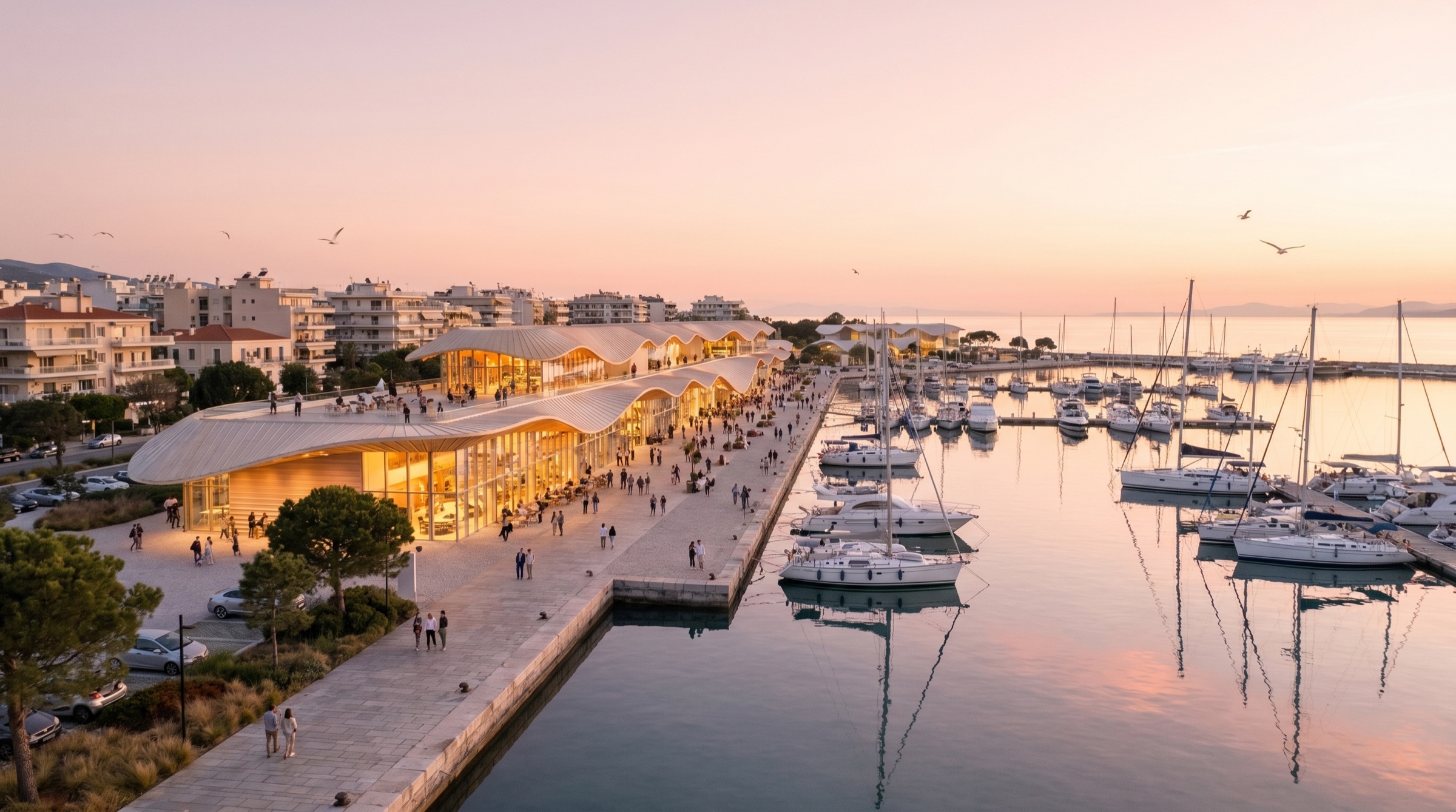
The Riviera Galleria is the retail spine: 23,000 square metres of retail and dining under a Kengo Kuma roof, structurally complete by late 2026 and operational by spring 2027. The East Village and Skyline Havens residencies are the high-density residential edge: 150 units launched in December 2025, another 350 due to market in mid-June, priced from €550,000 to €4.5 million. Both are pitched at a price point above the surrounding market. The point of the masterplan is to create a price-point environment, and the success of that environment depends on its difference from what surrounds it. Eighty-five percent of the first 671 units are already sold or reserved, with foreign buyers — Lamda's materials split them roughly between the Greek diaspora and international purchasers — taking close to half the inventory.
The macro frame
The Bank of Greece's May 2026 Financial Stability Review devotes a dedicated chapter to housing supply. The central bank flags the stock of homes pledged as collateral against unresolved non-performing loans as a structural drag on the market, even as the 2025 annual report records €4.7 billion in net bank profits, a system-wide NPL ratio of 3.3%, and a CET1 ratio of 15.3%. The banking system is healthier than at any point since the bailout. The housing supply problem is, by the central bank's own framing, not a balance-sheet problem.
Against that framing, the Greek state has tightened the demand side. The three-tier Golden Visa schedule was set by Law 5100/2024, effective 1 September 2024: €800,000 in Attica, Thessaloniki, Mykonos, Santorini, and islands above 3,100 population; €400,000 in the rest of Greece; €250,000 for commercial-to-residential conversions and heritage restorations. Law 5275/2026 (FEK A' 17, 6 February 2026) later added a post-acquisition short-term-rental ban on Golden Visa properties. Foreign buyers, including the documented Israeli segment profiled in the Greek English-language press, have driven volume in Athens neighbourhoods adjacent to the Hellinikon concession. Cumulative Golden Visa real-estate investment reported through 2023 sat around €5.54 billion, with much of it concentrated in Athens; the running total has climbed well beyond that since.
Scale comparison. Hellinikon against London and Athens public space.
Hellinikon is more than four times the size of Hyde Park and roughly 36 times the size of the Stavros Niarchos Foundation Cultural Center, Athens's most recent major public-space investment. Sources: Lamda Development concession documents; Royal Parks of London; SNFCC public information.
These are the conditions that make a Hellinikon-scale enclosure financially possible. A megaproject on a 6.2 million square metre coast does not get built on local incomes. It gets built on imported equity, on long-dated debt arranged through Greek and international banks, and on a residential market that has demonstrated it will absorb the high-end stock. The Greek state's role in producing those conditions, through TAIPED concessions, the Golden Visa programme, the post-bailout banking recapitalisation, and the planning approvals, is the load-bearing fact that the property-press coverage tends to leave out.
The Architectural Review's framing
A piece in The Architectural Review reframed the development under the heading "Agora phobia: Athens's privatisation of Hellinikon." The argument is direct. The agora is the public meeting ground of a city. To privatise the seafront is to privatise the agora's modern equivalent. The piece does not deny the project's design quality or the developer's commercial discipline. It locates the loss elsewhere: in the substitution of curated visitor space for unspecified public ground.
The framing is contested. Lamda's own materials emphasise the central park's scale, the public-transport commitments, and the open-access stretches of the coastal promenade. The state would point to the concession contract's terms. Both are correct as descriptions. The Architectural Review is correct that the difference between "public space written into a private contract" and "public space written into democratic land-use law" is not a difference of degree.
Who lives here next
A measure of the project's outcome, ten years from now, will be the demographics of the surrounding suburbs. Glyfada has been a high-end residential area for a long time. Voula, Vouliagmeni, Alimos. The arrival of Hellinikon has raised the floor on those neighbourhoods. Whether it has raised it past the point at which the next generation of Athenians can live in them is the social question the property data will eventually answer.
A second measure is whether the central park functions as a true civic ground. Hyde Park works because the City of London's planning constraints, the absence of a single private operator, and centuries of accumulated public habit make it work. A new park inside a privately curated masterplan, with its operating costs covered by the developer's revenue model, has a different test to pass. Athenians will decide it on a Sunday evening when there is no event scheduled and no entrance choreography to navigate.
A third measure is whether the casino-led model of "destination" tourism degrades or upgrades the cultural offer of the city. Hellinikon, with the Olympic Airways museum folded inside it, will be measured against the Stavros Niarchos Foundation Cultural Center and against the Acropolis Museum.
What we are watching for
In the next twelve months, three documents will tell us most of what we need to know about the project's trajectory. The first is the Lamda Development annual report, with disclosed figures for sqm sold, sqm reserved for public access, and the operating model for the central park. The second is the Bank of Greece residential property price index, broken out by Athens municipality, which will show whether the Hellinikon premium is spreading or staying contained. The third is the Greek Ministry of Culture's position on any Acropolis sightline question that emerges as the towers rise. Each document is institutional. None will be optional.
What the Editorial Desk will be reading for, in all three, is the same thing: what the price of Hellinikon's coastline turns out to be, and who pays it.
Frequently asked
What is Hellinikon, in one paragraph?
Hellinikon is the 6.2 million square metre site of the former Athens international airport and the Agios Kosmas seafront, sold by the Greek state through a concession to Lamda Development as a single integrated masterplan. It is the largest coastal redevelopment in Europe and includes a casino-led entertainment destination, a residential quarter, a commercial hub, an Olympic Airways museum, and a central park announced to be larger than London's Hyde Park.
Who owns Hellinikon?
The land was sold under concession by the Hellenic Republic Asset Development Fund (TAIPED). The developer is Lamda Development, a publicly listed company on the Athens Exchange. The casino component sits under a separate, 30-year integrated-casino concession held jointly by Hard Rock International (51%) and GEK TERNA (49%), branded Hard Rock Hotel & Casino Athens, awarded in 2022.
Why is the Hellinikon project controversial?
The substantive criticism, articulated most clearly by The Architectural Review under the framing "Agora phobia," holds that a 6.2 million square metre seafront sold to a single developer transfers what should be public agora into a privately curated environment. Public-space provisions exist in the concession contract, but they are not the same as public space produced by democratic land-use law.
How does Hellinikon affect surrounding Athens neighbourhoods?
Glyfada, Voula, Alimos, and Elliniko have seen residential price appreciation correlated with the project's progress. The Bank of Greece tracks the broader Greek residential property price index. The relevant question for the next generation of Athenians is whether the Hellinikon premium spreads or stays contained.
What should I read next?
The Editorial Desk will be tracking three institutional documents over the next twelve months: the Lamda annual report, the Bank of Greece residential property price index by Athens municipality, and any Greek Ministry of Culture position on Acropolis sightlines as the approved skyscrapers rise.
Early Insider access
The week, read against the long present of Greece.
The Editorial Desk sends one email each Sunday morning, Athens time, with no noise and no churn, written for the professionals and operators who pay attention to Greece because they live, build, or invest in it. Early Insider access is opening in limited spots and closes soon.